
LETTERS THROUGH TIME: POSTAGE STAMP
Where I speak of an old project and my art representing everyday life.

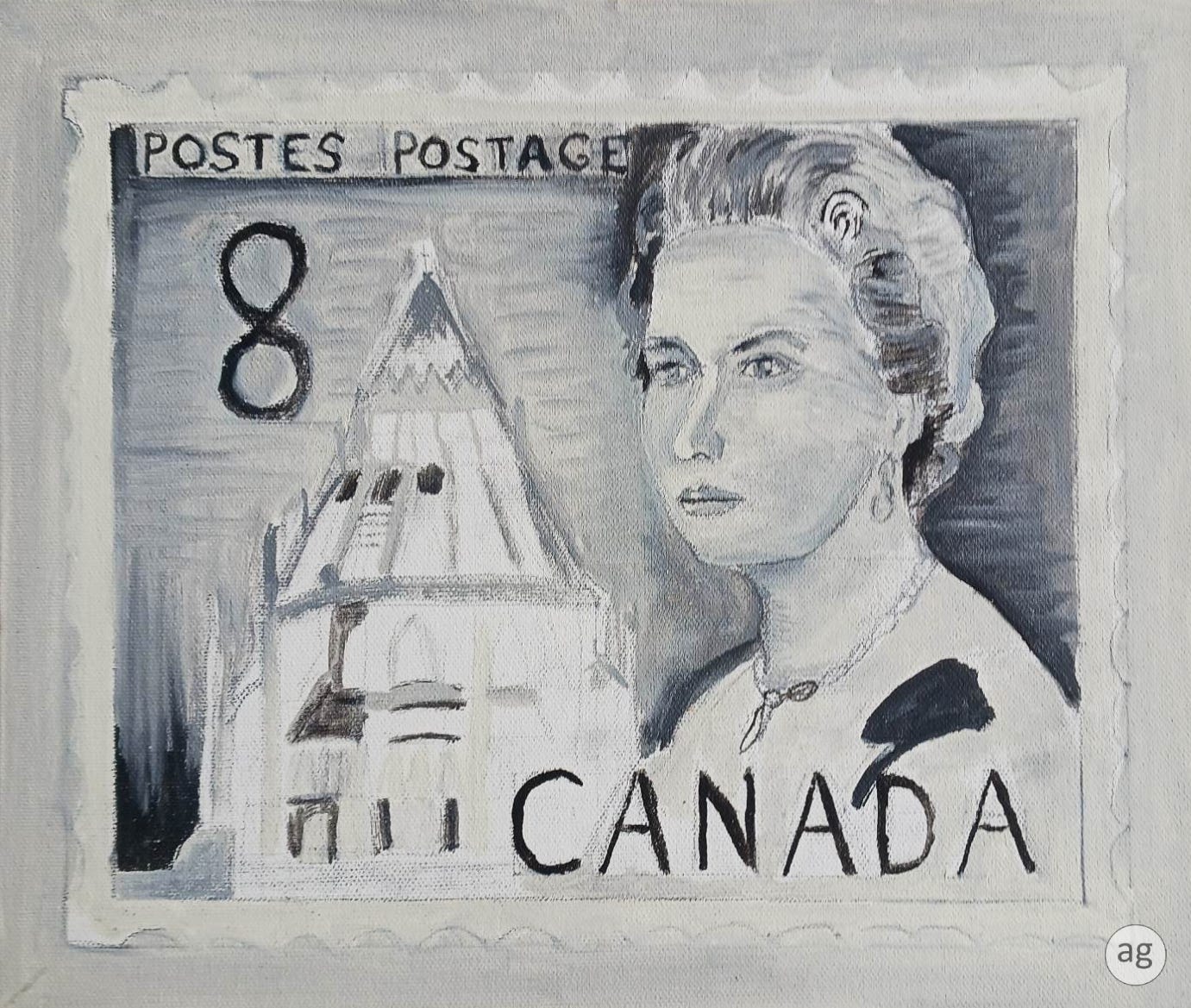
Here I present to you a copy that I made around 2002 of an 8 cent Canadian postage stamp from 1971 featuring a portrait of a young Queen Elizabeth II. This was part of a larger project I’ve mentioned before, called The Legal Tender Project where I was investigating the metaphysical and aesthetic qualities of paper money and related financial instruments, like bonds and other contracts, etc., checks also, and whatnot.
I was studying the history of paper money and coins as well, the look and feel of these things throughout history. Paper money from all across the world seems to have the same aesthetic qualities. The colors tend to be less saturated, there are usually portraits of leaders and other famous people, and there are visual design elements like geometric patterns and so forth. All currency the world over looks essentially the same. It was this quality of money/currency that I was trying to capture.
I had a stamp collection growing up, so one day I decided to paint a copy of one of the stamps in my collection. It happened to be a Canadian stamp with a portrait of Queen Elizabeth II. It could have been any other stamps. Stamps also have the same look and feel all around the world.
I like to "falsify" different kinds of documents. Starting in 2006, I had an entire project called "Writing-Without-Writing" where I began imitating old manuscripts from medieval times, the types of things you might find in a national archive. I was interested in imitating the look and feel of old paper. I used to collect old pieces of paper, actually, old newspapers that had yellowed over time, dirty pieces of paper I found strewn on the ground somewhere.
I was collecting objects from real life, and considered that I was painting my everyday life. I wasn't trying to make paintings of epic proportions, just painting things from daily life, what I had on my desk, what the floor looked like in my art studio, or what the paint looked like on the outside wall of an old building, or the pattern on the tiles in a hospital waiting room. I was representing things from my actual everyday life and I have continued to do this still to this day.
Some may think I'm an "abstract painter", but I don't see painters as being either "abstract" or "figurative". Different elements from a so-called "figurative" painting can be abstract, like the texture of the wall of an old wooden barn, or the pattern on a vase. When there is no discernible "object" in the painting, it's not necessarily "abstract". To me abstract art is made of "pure abstractions", either a "color field" or a geometric abstraction or something like that.
I was painting things I saw in my everyday life. Hence, I painted a postage stamp from my stamp collection, an object which I had sitting around in the office. Though I've seen other uses of the term, for the longest time I've called my style of painting "Concrete Realism". "Concrete Art" was an art movement with strong emphasis on geometrical abstraction, first formulated around 1930 by Theo van Doesburg. That's partly where I got the first term, "Concrete", except that I also meant that my art was not necessarily "abstract", as I mentioned above. It was concrete because I was painting things that were concretely real. I named it "realism" because I was a realist, I just wasn't a realist in the same style as the literary realists let's say of the 19th century. I found that their works were too "epic" in their proportions. I wanted to paint the everyday, so I came up with "Concrete Realism".
In a sense, I was profoundly influenced by the art and thought of Andy Warhol, though I will have to get into exact details in another post, of his influence mostly on my thinking, but on my art as well. What I can say for now, though, is that Warhol was in many ways representing things from everyday life in many of his works. His "Brillo Box" work was literally a reproduction on wooden boxes of a cardboard box that you might see in a warehouse. The way that I see it, Andy Warhol saw aesthetic beauty in a warehouse and wanted to transpose it into a more conventional art space.
I too have had such experiences. I have worked almost exclusively on cardboard for the last 20+ years, loving the look and feel of old carboard boxes, and enjoying cutting them up into pieces. It's how a postage stamp could become an aesthetic object for me, or money/currency in my other works at the time from the same project. I will leave it at that, I've already said enough. If one is attentive enough, one can find aesthetic beauty almost anywhere. I know few things in life, but I know this to be true. If you enjoy any of this, please send me a reaction or a comment below.
Sincerely,
A.G.
A.G. © 2023. All Rights Reserved.