
The Kubismus Algorithm: Map-Reduce Operators and the Dimensionality Reduction of an Aesthetic Problem
OFFICIAL STUDIO RELEASE | THE HISTORIOTHEQUE

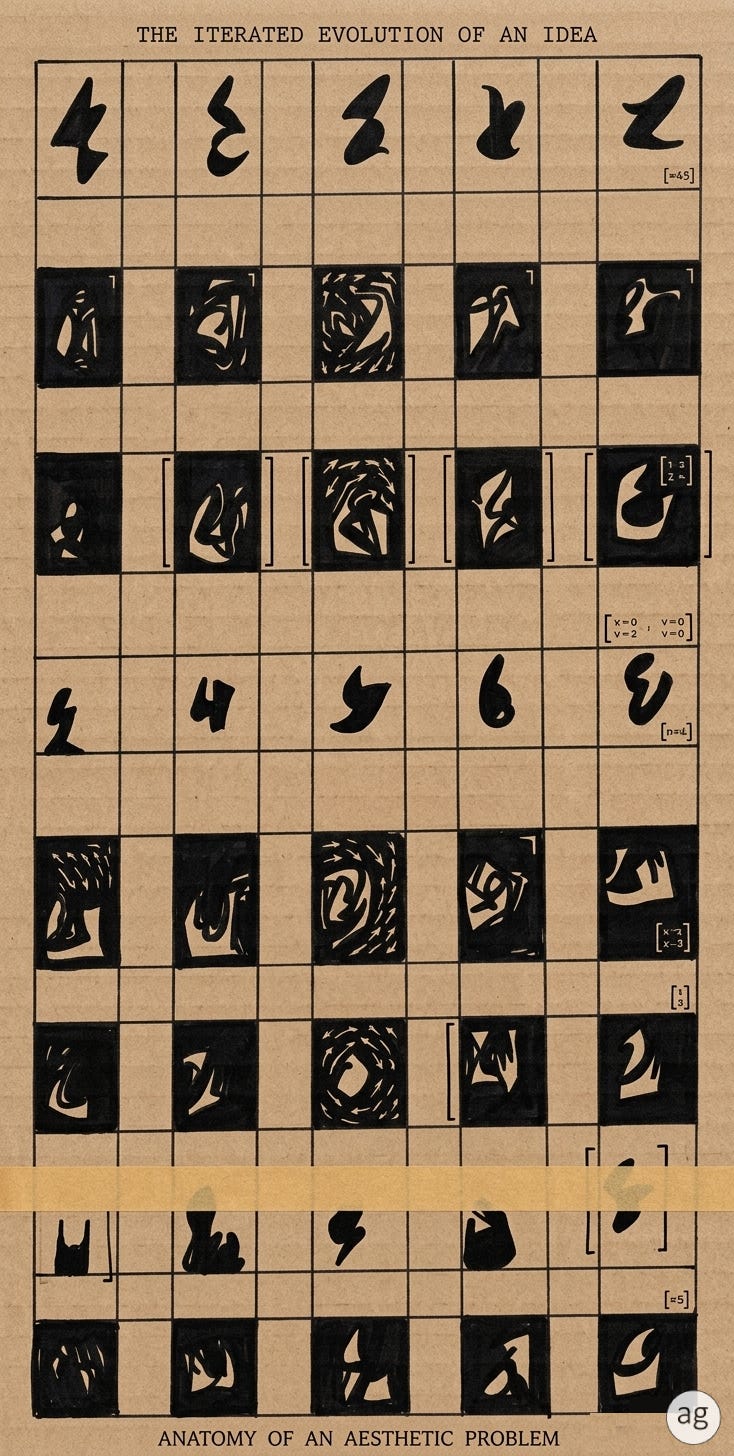
“THE KUBISMUS ALGORITHM”. Design concept by A.G. © 2026. All Rights Reserved.
OFFICIAL STUDIO RELEASE | THE HISTORIOTHEQUE
INTERMEDIA RESEARCH LABORATORY & ART OPERATION
TITLE: The Kubismus Algorithm: Map-Reduce Operators and the Dimensionality Reduction of an Aesthetic Problem
The newly initiated intermedia project, ANATOMY OF AN AESTHETIC PROBLEM, operating within the broader systemic framework of The Historiotheque, presents its latest visual iteration from the painting series THE ITERATED EVOLUTION OF AN IDEA. In this specific instance—manifested as a flat, two-dimensional grid drawn with black marker upon the raw, thermodynamic surface of corrugated cardboard—the studio isolates a foundational artifact: a structural montage simulating both a cinematic film strip and the computational architecture of a machine vision system. By encoding an improvised, analog “MapReduce” program across a 2D manifold, the work simulates the internal, linear-algebraic mechanics of artificial intelligence. It maps out a filtering procedure of primitive, gestural glyphs and reduces them to essential summary states, capturing the very manner in which an abstract mathematical intelligence might decompose, sort, and process spatial phenomena.
This visual system functions explicitly as what can be defined as a machine for seeing. In historical alignment with the Master painters who consistently endeavored to innovate new cognitive lenses, this piece repositions the early 20th-century breakthroughs of Cubism as early, non-digital algorithms of spatial computation. When André Salmon famously described the radical, fractured geometry of Pablo Picasso’s Les Demoiselles d’Avignon as “naked problems, white signs on a blackboard,” he was identifying an identical drive toward dimensionality reduction. The early Cubist masters were not merely flattening space; they were running a highly sophisticated, cinematic montage process across the canvas—a proto-cinematic sequencing that remains a deeply undervalued aspect of their historical legacy. By treating the canvas as a systematic processor, Cubism operated as an analog computational grid that broke down multi-dimensional reality into discrete, flattened packets of structural information.
By synthesizing these historical lineages with contemporary machine intelligence paradigms, this artifact offers an elegant solution to its own self-contained aesthetic problems. The alternation between positive and negative frames across the grid establishes a strict binary oscillation, transforming the raw, coarse texture of the corrugated substrate into a site of high-level theoretical inquiry. It bridges the gap between historical “systems of seeing” and modern machine learning processing, demonstrating that the painter’s grid and the matrix of linear algebra are merely iterations of the same timeless pursuit: capturing the raw anatomy of a problem, stripped bare upon the blackboard of human and machine consciousness.
Systemic Status: Active Activation.
The Historiotheque Art Operation, June 2026.